Tuesday, December 2, 2014

Lofting 101

My last blog was on November 15 when we were preparing the shop floor for lofting. Since then we have worked continuously on lofting "The Sixteen" with the exception of the Thanksgiving break. I will attempt to describe what I have been doing without writing a short novel. To be honest I find lofting to be fun but lofting is also tedious, frustrating and at times just plain confusing (and why I have probably not blogged for two weeks). The good news is that other than some beginning projects that may relate to boatbuilding (rabbet, carlin, etc.) this is the start of real boatbuilding. Drafting and recreating the lines of the boat in full size on the lofting floor is only a fraction of the boatbuilding process. The process really begins to take form in creating developments and molds.

The lectures on lofting which have spanned several weeks now were given by the school's senior instructor and master boatbuilder. Jeff has been a boatbuilder for 30+ years and apprenticed under the school's founder, Bob Prothero. His experience and knowledge was further demonstrated in the fact that all of the instructors attended his lectures along with the students. One of the first things Jeff said when talking about boatbuilding is to “strive for perfection and settle for a little less”. I think this is great advice for someone new to boat building and maybe for life in general.


Some of the insight Jeff passed along in his discussion on lofting and boat building:
  1. Grid lines are actually planes. The line defines the boundary of the plane.
  2. Atkins plans have errors in the table of offsets (you have been forewarned).
  3. Waterlines, butt lines and diagonals are just tools to fair the body plan lines. Diagonals help square off the body plan. The body plan is the most important of all the lines because it gives shape to the hull. The body plans contain 85-90% of the useful information.
  4. The Sixteen is similar to a Herreshoff 12 ½.
  5. Fairing lines is similar to music but using your eyes instead of your ears.
Skeg built vs. Built down (what is done out here)
Built Down: constructed with the frames or hull bottom joining the keel in a plane nearly parallel with the sides of the keel, forming an S-curve from rail to keel.

Skeg Built: constructed with the frames or hull bottom joining the keel in a plane nearly perpendicular to the sides of the keel

Skeg built boats are said to be more stable with large loads, faster and generally lighter while built down boats are said to be stronger and more seakindly. Both sides argue that one is superior than the other.

Difference between East Coast and West Coast boatbuilding. In the East they use a steeper dead rise due to the higher modulation of the wave action.
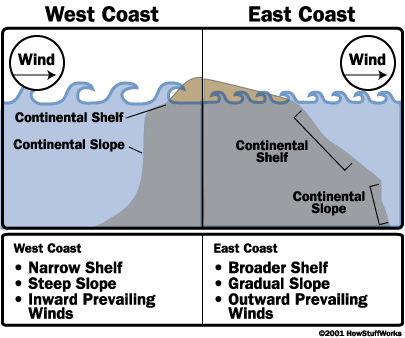

Boatbuilding Methods
A. Lofting lines – Developments
B. Spiling – using cheap material to fit a piece
C. Scribing – transfer shape from one piece to another, directly on material, one direction only
D. Fitting

Developments
A. Bearding line – inside surface of planking where it enters the backbone.
B. Rabbet – outside of the planking.

 1. Stem section:
  - Partial development of new body plan line squared off from the rabbet
  - New plane with different orientation perpendicular to the rabbet
C. Mold reduction - the depiction of planking (constant thickness), framing (constant thickness) and longitudinals. Expansion from outside planking to the edge of mold.
 1. Deck Camber:
  - Use maximum beam width
  - Rise = 1/2” per 1-0-0 of beam (Herreshoff = 3/8”/Culler = 3”) rounded up
 2. Longitudals:
  - Taper to half of midships thickness to be able to bend.
  - Spar Taper – divide length into four equal parts
 3. Bevels:
  - Make a bevel stick = 2x station length (48”) from the master bevel board, square off on station and read bevel on next station
  - For Sta 4 move Sta 5 forward
  - For Sta 1 add Sta 0.5 and Sta 1.5 (changed station distance – need new bevel board)
  - For Sta 7 measure 2” aft of 7 to create Sta 7.2, develop new body plan line
  - Why the bevel stick works? Difference in breadth between diagonals is equal to the bevel angle.
  - Clear bevel board (Mylar) width = at very least the total maximum mold reduction, parallel edges and approximately 18” long and up to 30 degrees
  - Measure total mold reduction for Sta_ on clear bevel board and use to mark mold.
  - Deck Centerline - determine the bevel on mold (at notch) from the shelf
  - Loft shelf and clamp vs. Spilling
  - Top of apron = 1 ¼” above back rabbet
D. Transom (curved, raked)

The elusive but most important book related to lofting:


Ship and Aircraft Fairing and Development, for Draftsmen and Loftsmen and Sheet Metal Workers by Samuel Supplee Rabl


Yankee Tender

This is the boat we will be building as the final part of the first semester utilizing all the skills we have learned to date. Construction will start this week and finish prior to the Winter break. We will be using western red cedar as our primary material and will deviate from the plans in building only a single layer planked bottom. 

The “Yankee Tender” is a Wooden Boat Magazine refined design of the original “Thomson skiff-tender”, built from the early 1900’s to about 1935 by Cape Cod boatbuilder Asa Thomas of New Bedford, MA. It is known for it’s light weight, elegant lines, rowing ease, and sea worthiness as it was designed to handle the choppy waters of Buzzards Bay in Cape Cod, Massachusetts. It was used both as a skiff to get out on the water and fish out of, as well as being used as yacht tender.

The original “legendary” design by Asa Thomas was 10’ LOA with 3 strakes. Asa Thomas was known for his fine craftsmanship and exacting standards. Maynard Bray, Spencer Lincoln, Joel White and Jon Wilson, all of Wooden Boat magazine, teamed up and refined Thomas’s design and stretched it 12’-4” LOA, added a forth strake, and further raked the transom and the stem resulting a bigger boat, and more pleasing lines, yet it still rows with ease due to the rocker flat bottom

The boat is built primarily of cedar (strakes, thwarts, sternsheets), with an oak stem, transom, keel, rails and delicately tapered frames. The strakes are riveted together with copper nails and roves. All other fasteners and hardware is of silicon bronze. The chines and seat knees where steam-bent to shape. The outside is painted and the inside is oiled with a homemade varnish recipe called “boat soup” or “boat sauce”, an old down east deck coating formula consisting of a mixture of Boiled Linseed Oil, Turpentine, Pine Tar, and Japan Drier.

The boat rows with ease due to its rocker flat bottom which helps to keep the transom bottom out of the water, thus reducing drag. It will carry three adults. With one or three persons on board, the normal rowing position is the center thwart. With 2 persons on board, the rower sits on the forward thwart and the passenger sits on the sternsheets to keep the boat rocker balanced.

In Thomson’s day the 10’ skiff-tender complete with leathered oars cost $140 (not so cheap in those days) and he charged $1.25 per hour for his labor.


Petrel - 1928 42' Converted Salmon Troller

This is exactly the kind of boat I hope to have someday...

Petrel


This Pacific Northwest workboat conversion is enduring and endearing
Chris and Kathy Grace have owned other boats, but Petrel was the ideal choice for cruising the changeable waters of the Pacific Northwest.
It’s nearly a law of nature: A boat voyeur’s stroll through the Boat Haven in Port Townsend, Washington, stops on B-Dock. That’s where Petrel is tied up, and that’s where anyone, even folks who don’t know much about boats, pause to stare. She’s a converted salmon troller of modest size at 42 feet overall — a vessel so cute, so right, so honest, she’s like that perfect little boat a kindergartner might draw from imagination.


There’s the prominent bow with a massive, heavy-duty windlass that carries hundreds of feet of galvanized chain on the foredeck; the imposing trolling poles lashed astride her mast abaft the classic fishboat wheelhouse; a springy sheer line that is accentuated by a varnished caprail and a light gray rubbing strake; and a pinched stern that makes her a double-ender in the Scandinavian tradition. Conceived and built for the waters of the northeastern Pacific, Petrel is also in fine fettle despite her semibiblical age of 86 years.
She’s owned by Chris Grace, a retired commercial real estate developer who used her to cruise with his wife, Kathy, a nurse, on Puget Sound, in the San Juan and Gulf Islands and up to Desolation Sound in British Columbia. He calls Petrel the “center of our boating universe,” which is a statement of some import, given that they also owned and cruised a 39-foot Concordia yawl and raced an Etchells.
But in the end, Petrel, with her no-nonsense workboat qualities, proved to be the boat best suited for cruising these beautiful but challenging waters. They’re placid one moment and rough the next, churned by wind that runs counter to some rapacious currents. “Sailing is great, but it is easier and better to explore [these waters] while motoring,” Grace says. “Besides, we wanted to stay out longer than one month, and that’s just hard on a sailboat.”
OK, so power beats sail in this scenario. But why select a converted workboat with limited comforts and one that’s built of wood, to boot? “We didn’t do it for wood worship but because we wanted to be practical,” Grace explains. They looked at Grand Banks, Romsdal trawlers and a William Garden design, but Petrel got the nod, in part because her previous owner, who restored and converted her from a Pacific salmon troller into a cruising boat, refastened her Port Orford cedar planks with bronze. Another reason was her size. “When you think living quarters, you always want bigger,” Grace says. “But when you think about managing and maintaining a boat alone or with two, you want smaller, and 35 to 45 feet is ideal for a couple to handle.
“I wanted a boat that I can stare at when I row away from it in an anchorage,” Grace chuckles over a glass of single malt. “Like anything that’s been well designed and made, Petrel follows the Golden Rule. Take a Mustang P52 fighter plane or a Jaguar E-Type sports car. Really, what would you change? These are timeless designs that conform to the rules of aesthetics.”
It is doubtful that aesthetics played a leading role when the vessel was designed and built in 1928 in Astoria, Oregon, by Matt Tolonen at the Columbia Boat Building Co. Builders also were designers 
A drop-down chart table comes in handy near the helm.
then, but that job was not as fancy as a yacht designer’s. “They made half models and later also drawings and [just] built boats,” says John Norgaard, a second-generation immigrant from Norway and a retired fisherman in the area, who learned the craft from his father. “A guy would come and say, ‘I want a boat like [this], only two feet longer and a foot wider,’ and that’s what he’d get.” Petrel’s first owner was Matt Sorvaag, a sailor by trade, also from Norway, who is said to have fished her until his death in 1950.

And fish, so goes the yarn, loved Petrel. Why that is, nobody really can explain. Perhaps they fancied a boat that slices through the water efficiently with a modest and clean wake; Petrel had the inside track with her pointy stern, which takes a page from the tradition of the Vikings. Key characteristics of Viking vessels were seaworthiness, speed and benign behavior in the difficult conditions Petrel might have found during her work life, crossing the treacherous bar of the Columbia River or on her far-ranging trips into the Gulf of Alaska.

“These boats were built to pack fish and take the weather, no matter where,” says Norgaard. “They had living quarters and fish holds that packed ice and were large enough to stay out for days at a time.” Later, he says, full sterns became common because boats had to carry more load. However, as a yacht, Petrel’s pointy end puts her in good company with designs by L. Francis Herreshoff, Bruce King and Ray Hunt or the seminal cruising boat of the 1970s, the Westsail 32, which is linked to Eric, designed by William Atkin in 1928, the year Petrel was built. Atkin, in turn, was influenced by the double-ended pilot boats designed by fellow Norwegian Colin Archer. Later, Bill Crealock and Bob Perry continued this school of thought with stout cruising boats, such as Pacific Seacrafts and Tayanas.


Life on board Petrel moves at a measured pace, between 7 and 8 knots. She’s been repowered a couple of times since her launch, when she was fitted with an Atlas Imperial 3-cylinder, 30-hp diesel. Now she’s propelled by a 100-hp 371 Detroit Diesel that will take about 2 gallons per hour for doing its job reliably and with a workboat soundtrack. It is installed under the wheelhouse and accessed through a hatch in the sole. The helm station is to port, but the large windows offer 270-degree visibility and an outward-opening door on each side. These provide quick access to the side decks — critically important while fishing for easy communication between skipper and crew, which consisted of one deckhand or maybe a couple of family members.
The accommodations are spare, but the lean beauty of Petrel is apparent in the details of her design.
Accommodations are spartan but adequate. Access is a concession to Petrel’s workboat origin and requires climbing down steep ladders, either into the crew quarters in the bow, which consists of two bunk beds and a stand-up desk, or into the former fish hold aft, where the galley and dinette are located. The ladders and the lack of a dedicated saloon for lounging with water views, not to mention the absence of a bow thruster and joystick, are conspicuous differences between Petrel and other trawler yachts. The head and shower are “upstairs” in the wheelhouse, to port, abaft the steering stand. A neat workboat detail that Grace likes to demonstrate is the drop-down chart board, which is fastened to the overhead.

Grace doesn’t mind picking up sandpaper and a varnish brush or scraping the bottom when Petrel is hauled out. “He spent a ton of time upgrading the boat,” notes Ted Pike, the owner of Annie Too, a Bill Lapworth sloop, and a salesman for Edensaw, a wood supplier in the Pacific Northwest. “Her workboat layout might be a bit awkward for leisure, but she has a sweet motion that makes her comfortable underway.”

Stopping off Port Hadlock, Grace lowers Petrel’s impressive trolling poles 40 to 50 degrees and deploys stabilizers suspended from each pole to ride 10 to 15 feet below the surface, reducing the rolling motion. ”They increase the beam of the boat and its stability,” he says.


During fishing duty the stabilizers would be closer to the hull because several trolling lines would be rigged farther up on the poles, each set to different depths, weighed down by a “cannon ball” of lead and carrying several “spreads” with leader, lure and hook. Tag lines or inhauls would be run to the stern, where the trollerman would reel in the catch.
Petrel heads for bigger water, looking much as she always has, with stabilizing troller poles ready for action.
But those working days are long gone, although Petrel still carries a workboat permit. It comes in handy for jumping the line at the Ballard Locks in Seattle on the way to the Lake Union Wooden Boat Festival. She has been a fixture at such events and has won several awards for best conversion. But that’s just gravy because she’s cruising between 60 and 90 days a year, which means she’s a frequent guest in many places. And sometimes getting there is just as tough as it would have been getting battered in a gale with a hold full of fish or negotiating the bar. “I remember one rough trip to Friday Harbor,” Kathy says. “Chris was just climbing down into the forecabin with Bones [the couple’s Jack Russell terrier] under one arm, and just as he let go of the ladder we took a hit.” Without a hand for himself, he went flying and landed hard. The pooch was fine, but the skipper was dinged up. Nothing bad, but the incident and the bandage made for a good yarn at the dock. And Petrel? She kept calm and carried on, none the worse for wear.

Her name references a seabird in the southern latitudes that travels far to chase fish. Like these daring fliers, Petrel is highly adapted to her environment, with a form that follows function. But she also has a knack for finding owners who render the necessary care, which is why she’s still kicking after all these years. At the time of this writing, she was about to leave the Boat Haven in Port Townsend to move to Bainbridge Island, where her next owner plans to keep her. Though she won’t be trolling for salmon anymore, her conversion hasn’t diminished her character. She can still take what the ocean throws at her while pleasing connoisseurs and looky-loos alike with her traditional features and proportions. And don’t forget the kids, who will always draw boats like her when their fantasies are spilled on a plain sheet of paper.

Specifications
LOA: 42 feet
LWL: 38 feet 
BEAM: 12 feet 
Draft: 6 feet 
DISPLACEMENT: 26 tons 
TANKAGE: 550 gallons fuel, 300 gallons water 
PROPULSION: 100-hp 371 Detroit Diesel 
YEAR BUILT: 1928 
BUILDER: Matt Tolonen/Columbia Boat Building Co., Astoria, Oregon


December 2014 issue

Saturday, November 15, 2014

Half-Hull Model and Lofting

Thursday and Friday I worked on creating a half-hull model from the plans we drafted of the Sixteen. The process begins with laying out the half-breadth waterlines on pine stock and then cutting the shapes out with the band saw. Once the waterline shapes are stacked in the correct order they are glued together with the assistance of toothpicks in pre-drilled holes (this is done to lessen the amount of movement when clamping the glued board). The glued stack of pine was left overnight to dry. Once the clamps were removed a profile of the boat was revealed. The sheer was then cut on the band saw. I screwed a piece of scrap stock to the back in order to easily place the upside down hull in a bench vise to start the process of removing the squared stock. With some effort and a sharpened spoke shave (love my Veritas!) it will take no time to start to create the correct shape of the hull. To be continued...

In preparing for Lofting of the Sixteen the rest of Friday was spent moving the contents of our workshop in order to lay down fresh sheets of door skin. When I left for the day, coats of white paint were being applied which should dry over the weekend and be ready to use on Monday. Teams of two will use approximately 2.5 sheets of plywood to draw the lines of the boat. Equipment needed for next week will definitely be knee-pads and slippers!

Thursday, November 13, 2014

All I Need to Know About Running a Boatshop I Learned in a Band

Professional BoatBuilder Magazine Online
Editor’s Note: While some people are lucky to have one great passion, John Harris has two: boatbuilding and music. The owner of Chesapeake Light Craft, the Maryland company featured in Professional BoatBuilder No. 152, studied music in college but before graduating in 1994 he lined up a job repairing old wooden boats. Today, his company is one of the most successful kit-boat suppliers in the world, selling more than 2,000 units annually. As Harris explains below, his success is thanks in part to lessons he learned in the music business.
* * *
A few years into my boatbuilding career, I reached a fork in the road: I had an offer to become a full-time musician. I stuck with wooden boats because it paid more, which tells you a great deal about a musician’s prospects. After that, I persisted in music semi-professionally, gigging once or twice a week until my daughter was born and the trombone was exchanged for playgrounds and Legos.
johnharris-jenedneyJen Edney
Boatbuilders, like musicians, never stop learning. “If you cringe when you hear someone referred to as a ‘master boatbuilder’ you’re an honorary musician,” writes John Harris, owner of Chesapeake Light Craft (above with trombone).
In moments of artistic darkness I ponder the preposterous expense of my music education, and wonder if all the years of music were wasted. But those years of orchestras, church gigs, jazz quintets, wedding covers, and indie rock bands have left me with indelible lessons about making a living as a working artist. And all boatbuilders are artists, as far as I’m concerned.
Getting good is very hard work. If you cringe when you hear someone referred to as a “master boatbuilder,” you’re an honorary musician. Musicians know that once you reach professional proficiency, after 10,000 or 20,000 hours of practice, only then do you realize how little you know. No one ever truly masters music, or boatbuilding. The best keep challenging themselves to grow as artists.
You need chops. One of the things I love about music is that there are no posers, at least not in the realm of classical and jazz. Even nonmusicians can tell if you suck. Thus, something like a true meritocracy exists in music. If you’ve got chops, you get work. If you don't, you won’t. The need for real, indisputable chops forces musicians to confront their weaknesses in ways that many professionals never do. The discipline of practicing, of being self-critical, of being determined to improve carries over from my music to my boatshop. I actively seek design and building projects that challenge me even when there isn't a clear profit objective.
Take chances. As a kid I was unusual for my willingness to do a lot of free gigs if I thought it was a good hang and I might meet better artists. I played coffeehouses for gas money in order to network with the guys getting gigs. Many of those jobs were dreary duds. A few connected in life-altering ways. Even with an established career as a boatbuilder, I still do a lot of volunteer and loss-leading work, and occasionally score a networking home run that pays off for years. You don't get to cherry-pick your gigs until you are old and revered, and I might never be either. So swing at all the balls.
Know how to be a leader and a follower. Nothing in music taught me more about life than watching great bandleaders on the stand. They know when to give concise direction, when to be politicians, and when to get out of the way of the music. Perhaps the most valuable lessons came from watching talented leaders grab their axe, take a seat with the rank and file, and blend in seamlessly when that’s where they're needed most. The leader of an artistic enterprise, like a boatbuilding shop, needs to be impresario one moment, 5-Minute Manager the next, and a few moments later just another working boatbuilder.
Put your best people out front. There’s a species of bandleader who wants to give weak players the chance to solo, y’know, so they can get some experience. Don’t do it. “Practice at home” is the professional musician’s refrain. A band might make hundreds of first impressions in a single night. People will remember the guy who can't play in tune. Whether you’re at a boat show, running a showroom, or meeting clients, you want the guys with the knowledge and the talent, along with your very best examples of boatbuilding, making all those first impressions. Is that boat not ready for the boat show? Skip the show or leave the boat at home. That's smarter than making a lousy impression.
The steady guys keep the gigs. You know the type. Movies are made about them. Wildly talented, all the chops in the world, but they’re late to the gig, drink too much, and antagonize their bandmates. Boatbuilding, like music, is a really hard way to make a living, and there's just no room for flakiness. Value the people who are “merely” very good, who show up every day and get things done. Tolerating talented head cases—instead of sacking them—is going to demoralize everyone. Let them drag down some other band.
Sweat the small stuff. When you hear the London Philharmonic, the reason it’s perfect is that all those musicians are getting a thousand tiny details exactly right. The Beatles? Same thing: George Martin and the boys always made sure the pieces fit together perfectly. Great art is always about the details, and you fumble them at your peril. From Steve Jobs to Yo-Yo Ma, from Nautor's Swan to L. Francis Herreshoff, it comes down to not considering any detail too small to be worthy of time and attention. [Sweating the small stuff is also highly recommended by our technical editor Steve D’Antonio. Read his column about it in Attention to Detail.—Ed.]
Stagecraft matters. When you think of musical “stagecraft,” the overwrought antics of pop stars might come to mind. But at the level of the workaday musician, it means a host of small things that add up to a polished performance. Being dressed neatly and appropriately; not shuffling your music or fumbling for gear between songs or grimacing at mistakes; avoiding overlong or inarticulate introductions to songs. In the boatshop, this is what I call “presentation”: making sure that the packaging, documentation, display, and press materials of my boats match the quality of the product. This can be expensive and time-consuming, but presentation issues are a major line item on quality control checklists at my shop.
I loved the music. I loved the stage, the people, and the business. At Chesapeake Light Craft, a creative organization with about the same head count as a swing band, I draw on my musical experiences every single day. I wish more boatbuilders thought of themselves as artists, and more musicians thought of themselves as businessmen.
John Harris

Wednesday, November 12, 2014

Is it Fair?

One of the definitions for the word "fair" from Merriam-Webster is...pleasing to the eye or mind especially because of fresh, charming, or flawless quality. This definition most resembles the use of the word fair when describing the lines of a boat. Or as my instructor would say, a fair line is any line that when drawn requires a choir of angels from heaven to sing. Today was Day 3 (off for Veterans Day yesterday) of the Drafting Course. We are working on the "Sixteen" which is as you may have guessed a 16-foot long boat. You may ask why not just use a computer-aided-design program? Good question. I think the purpose of drafting the lines of a boat by hand is part of the natural process of learning why and how things are done. The information learned in drafting will be applied to the lofting process but in a larger scale. Besides drafting can be fun! How fun is it to have the computer do all the work for you? The main purpose of drafting (by hand or computer) is to fair the lines of the boat for planking. The process of drafting the lines will ultimately correct and prove out the fairness before lofting.

The lines of the boat are shown in three views:
  • Plan view (looking forward and aft)
  • Profile (side view)
  • Half breadth (looking from above down on half of the boat)
The process of drafting can be simplified into the following steps:
  1. Drawing the grid (baseline, center line, aft and forward perpendiculars, water lines, buttocks and diagonals) on the backside of the vellum.
  2. Drawing the master lines (sheer, stem/keel, rabbet, transom rake and load water line) on the front side.
  3. Drawing Stations 2,4,6 and the Transom.
  4. Developing Water Line 2A
  5. Developing Diagonal C
Once those lines are plotted the remaining water lines, buttocks and diagonals can be developed. The transom is also rolled-out in detail as well. Finally, comparing the lines plotted in the half-breadth view and profile can be compared to the plan view thus "proving out" the correctness of the lines.

On Friday we will take our drawing and use it to build a half-hull model of the boat. On an interesting side note...Sean showed us today how to use a "Half-hull Contraption" to develop the station lines from a half-hull model. This is basically the reverse of what we are doing in class. In some instances a half-hull model is built by hand and the lines are faired by eye. This information is than transferred from the model to the hull. Pretty cool indeed!


Thursday, November 6, 2014

Here comes the Vikings!

During lunch yesterday, Leah from Northwest Sails gave a presentation "Sailing a Danish Viking Ship in the Baltic Sea". This past summer she was the only American to be part of the crew sailing (and rowing) the Sea Stallion from Glendalough. The Sea Stallion is part of the collection of reconstructed Viking Ships of the Danish Viking Museum (http://www.vikingeskibsmuseet.dk/). Leah spent about three weeks and 400 nm traveling around Denmark, Germany and Sweden. To say that this was an adventure would be an understatement. Sixty crew plus the Captain and Mates in an open boat with only two buckets to serve as toilets is probably a little more than an adventure. No wonder the Vikings pillaged when they reached their destination! Below is some detailed information on the vessel.


Sea Stallion from Glendalough

The longship, Sea Stallion from Glendalough (in Danish Havhingsten fra Glendalough), is the largest vessel the Viking Ship Museum has build so far. With a length of 30 m, it is indeed in a special class among Viking ships. The Norwegian Viking finds, the Oseberg and Gokstad ships, are "only" 22 m and 24 m long respectively. The famous great-ship of the Norwegian king, Olav Trygvasson, "Ormen hin lange" (Long Serpent) was, according to Snorre's saga, all of 43 m long!

As can be seen in the museum hall where the original longskip is exhibited, only about 25% has been preserved. That it is possible to build a satisfactory reconstruction is solely due to the fact that the 1800 fragments that were found included essential parts of the bottom, the whole keelson and the stern - and the ship's side adjacent to the stern, right up to the gunwale. Hence, the most vital measuring points still exist.

High-quality materials were used in building the original ship, not only for the sake of appearance, but also to enhance the strength of the construction. It thus became necessary to select material for the reconstruction which as far as type and properties are concerned, came as close as possible to the original.

The Vikings built their ships of fresh wood. The long planking for the ship's sides, the strakes, were cleaved from long, straight oak trunks, while the inner and more curved timbers were made from parts of the oak tree crown that had already grown into more or less the correct form. The total volume of wood required for the reconstruction is 150 stacked cubic metres. Then there are 400 kg of pure iron, hemp for the 3000 m of rope, and a great deal of flax for the sail, all 112 square metres of it!

Judging by the most recent wood and tree-ring analyses, the original ship was built in accordance with Scandinavian shipbuilding traditions in Dublin around the year 1042. The ship is thus linked with the Scandinavian expansion westwards and the history of the Vikings in Ireland. Without doubt the ship was also on the scene of many dramatic events that occurred at the end of the Viking Age, after William the Conqueror invaded England in 1066.

The reconstructed longship was launched in 2004. Hereafter the initial sea trials and crew training took place in 2005 and 2006. Further experiments was conducted to establish sailing characteristics and seaworthiness on different types of seas and weather conditions.